
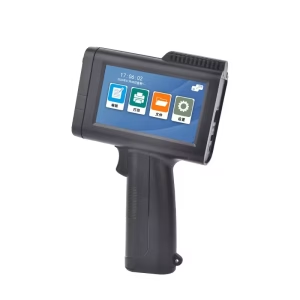
Case coding printers are specialized devices designed to print alphanumeric codes, barcodes, logos, and other critical information on product packaging, such as cartons, cases, or crates. These printers play a pivotal role in supply chain management, enabling traceability, compliance, and efficient inventory control. Unlike standard printers, case coding printers are built to handle industrial environments, diverse materials (e.g., cardboard, plastic, metal), and high-speed production lines. This article explores their types, features, applications, benefits, challenges, and future trends.
Table of Contents
ToggleTypes of Case Coding Printers
1. Continuous Inkjet (CIJ) Printers
- How They Work: CIJ printers propel solvent-based ink through a nozzle, creating a continuous stream of droplets. Electrostatic charges deflect droplets to form characters on the surface.
- Pros: High-speed printing, suitable for porous/non-porous materials, and effective in dusty environments.
- Cons: Regular maintenance required; solvent inks may emit volatile organic compounds (VOCs).
- Use Cases: Beverage cans, cardboard boxes, and automotive parts.
2. Thermal Inkjet (TIJ) Printers
- How They Work: Heat-generated bubbles force water-based ink through printheads.
- Pros: High resolution, low maintenance, and eco-friendly inks.
- Cons: Slower than CIJ; less durable on non-porous surfaces.
- Use Cases: Food packaging, pharmaceuticals, and electronics.
3. Laser Coding Printers
- How They Work: Lasers etch or oxidize surfaces to create permanent marks.
- Pros: No consumables, contactless, and high precision.
- Cons: High upfront cost; limited to certain materials (e.g., metals, plastics).
- Use Cases: Medical devices, luxury goods, and aerospace components.
4. Thermal Transfer Printers
- How They Work: Heat transfers ink from a ribbon to the substrate.
- Pros: Durable prints; ideal for flexible packaging.
- Cons: Ribbon costs add up; slower speeds.
- Use Cases: Labels, poly bags, and shrink sleeves.
5. Drop-on-Demand (DOD) Inkjet Printers
- How They Work: Ink droplets are ejected only when needed, reducing waste.
- Pros: Energy-efficient, variable data capability.
- Cons: Moderate speed; ink compatibility constraints.
- Use Cases: Secondary packaging, perishable goods.
Key Features
- Durability: Built to withstand harsh industrial conditions (dust, moisture, temperature fluctuations).
- High-Speed Printing: Speeds up to 1,000+ characters per second (CIJ).
- Connectivity: Integration with ERP systems, IoT, and cloud platforms for real-time data.
- Software Compatibility: Supports variable data printing and complies with standards like GS1.
- Versatility: Adjustable printheads for uneven surfaces and diverse materials.
Applications Across Industries
- Food & Beverage: Expiry dates, batch codes, and nutritional info.
- Pharmaceuticals: Batch numbers, serialization for anti-counterfeiting.
- Logistics: Barcodes, QR codes, and tracking numbers.
- Manufacturing: Part numbers, assembly instructions.
- Retail: Pricing, promotions, and inventory management.
Benefits
- Efficiency: Automated, high-speed printing reduces manual labor.
- Accuracy: Minimizes human error in critical data.
- Compliance: Meets FDA, EU, and industry-specific regulations.
- Cost-Effectiveness: Lowers operational costs over time compared to manual methods.
Challenges and Considerations
- Initial Investment: High upfront costs for advanced systems like laser coders.
- Maintenance: Regular cleaning and part replacements (e.g., CIJ nozzles).
- Material Limitations: Some technologies struggle with glossy or irregular surfaces.
- Environmental Impact: Solvent inks require proper disposal; VOC emissions.
Future Trends
- Smart Manufacturing: Integration with AI for predictive maintenance and defect detection.
- Eco-Friendly Solutions: UV-curable and water-based inks reducing environmental footprint.
- Hybrid Systems: Combining technologies (e.g., inkjet + laser) for multifunctional coding.
- Industry 4.0: Real-time monitoring via IoT and blockchain for enhanced traceability.
- Touchless Coding: Advancements in laser and inkjet systems for non-contact marking.
Conclusion
Case coding printers are indispensable in modern supply chains, ensuring products are labeled accurately and efficiently. From CIJ’s versatility to laser coding’s permanence, each technology addresses specific industry needs. While challenges like costs and maintenance persist, innovations in connectivity, sustainability, and automation are driving the sector forward. As global trade and regulations evolve, case coding printers will remain central to achieving transparency and operational excellence.